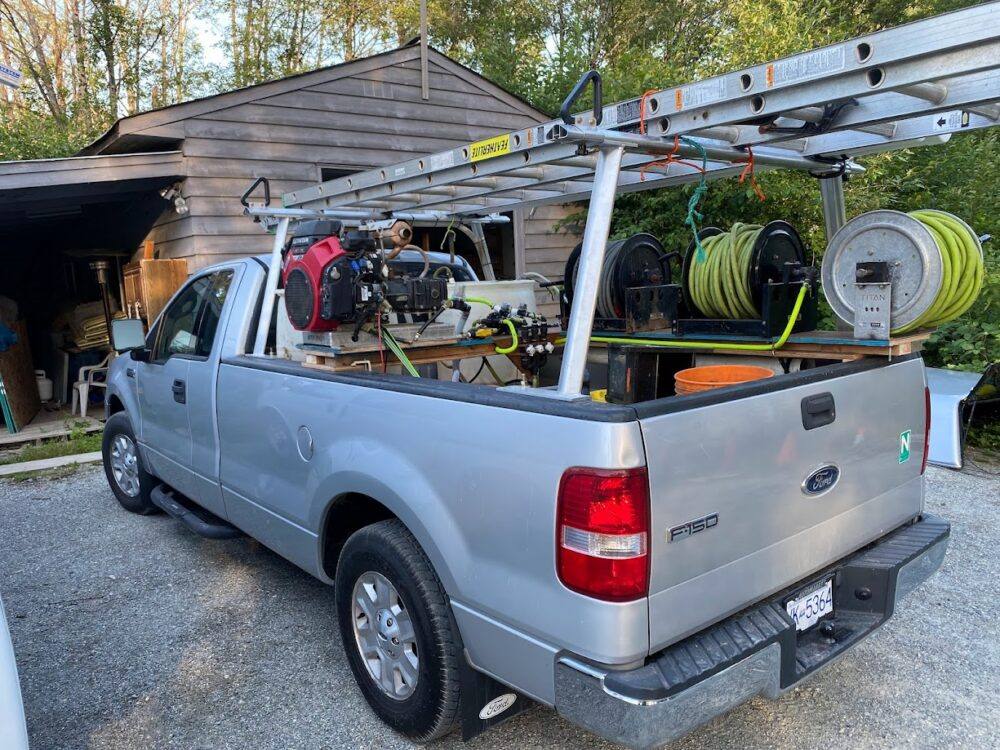
What snow plow software has to do on a storm night
Snow work comes in short, hard bursts. One storm can mean a long list of sites in a single night, and every one needs to be cleared, proven and billed. Good snow plow software should handle these jobs without paper or group texts:
- Keep each site's terms. Seasonal, per-push, per-event or per-inch, written once and used for every bill.
- Send routes to drivers. Build routes by zone and show them on each driver's phone when a storm starts.
- Prove the work. A time stamp plus before-and-after photos for every site visit.
- Count salt. Log the salt or de-icer put down at each stop, so material is billed and costed to the right site.
- Track crew hours by job. Drivers clock in and out from the app, so you know what each site really took.
- Turn visits into invoices. Logged services become bills that show what's owed and what's been paid.
- Bring accounts back next winter. Renewals and follow-ups, so seasonal customers re-sign on time.
If you also cut grass in summer, the same customer list and crew app carry over. See CrewBrain for landscaping and lawn care crews.
How a snow removal job is priced from its real costs
Snow contracts come in three main shapes. Per push means one charge each time you plow the site. Per event means one charge per storm, however many times you go back during it. A seasonal contract is one fixed price for the whole winter. Per push and per event leave most of the weather risk with the customer. A seasonal contract moves it to you.
Whatever you sell, start with the cost of one visit. Take the crew hours (including drive time and setup) and multiply them by the full cost of one person-hour. That full cost is the wage plus payroll taxes, insurance and workers comp. Add materials, and the truck and fuel. Then divide by one minus the margin you want. Office, ads, software and your own pay all come out of that margin. The labor burden calculator helps you find your real hourly cost.
Here is one small commercial lot, with one truck and one driver (illustrative numbers):
| One push | Math | Amount |
|---|---|---|
| Crew time | 1.5 hours (drive, plow, clean up) × $40 full cost per hour | $60 |
| Truck, plow and fuel | 1.5 hours × $30 | $45 |
| Job costs | $105 | |
| Price at a 40% margin | $105 ÷ (1 − 0.40) | $175 |
Salt is left out on purpose. Bill it as its own line, because ice, not snow, decides how much you use.
Note the divide step. Adding 40% to $105 gives $147, which is only about a 29% margin. That gap is the difference between margin and markup.
Now say you sell this lot a seasonal contract. You expect 12 pushes in a normal winter, so you charge 12 × $175 = $2,100. Here is what happens when the winter does not follow your plan:
| Winter | Pushes | Job costs | Seasonal contract pays | Left for overhead and profit | Per push would pay |
|---|---|---|---|---|---|
| Light | 6 | $630 | $2,100 | $1,470 | $1,050 |
| Normal | 12 | $1,260 | $2,100 | $840 | $2,100 |
| Heavy | 22 | $2,310 | $2,100 | −$210 | $3,850 |
Illustrative numbers only. Use your own crew cost, truck cost and push counts.
At 20 pushes the contract only just covers its job costs, with nothing left for overhead. Every push after that costs you money. A light winter pays you well, but you can't count on one.
For trigger depth, standby costs and salt pricing in more detail, read how to price snow removal jobs so each one makes money, or run your own numbers in the job price calculator. CrewBrain adds up the crew time, drive time, materials and vehicle cost of every job, so you can see which sites earn their price.