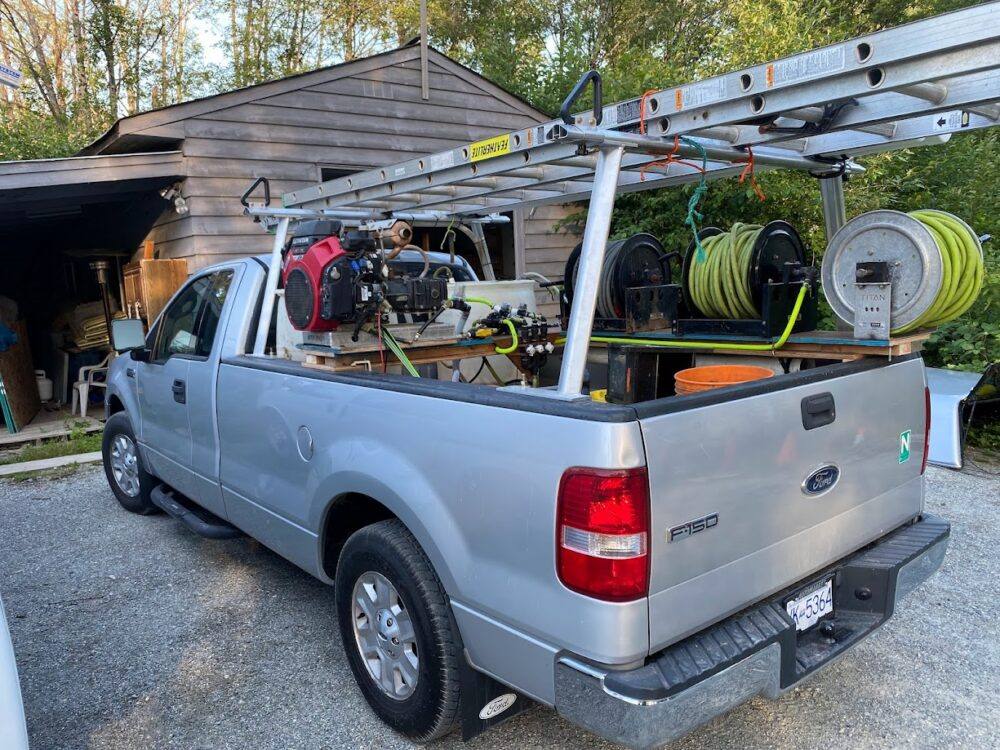
Driveway washing is usually priced by the square foot with a job minimum, or as one flat price by driveway size. Whichever way you quote, check it against the real cost of the job.
What customers pay to have a driveway pressure washed
Start with the going rate, so you know what the customer has in mind before you call. Big homeowner cost guides publish US numbers.
- HomeAdvisor puts a professional driveway wash at $100 to $350, and says most homeowners pay around $210 (checked October 2026).
- The same HomeAdvisor guide gives a range of $0.30 to $0.55 per square foot (checked October 2026).
Use these as a sense check, not as your price. They are written for homeowners, they mix many markets together, and they know nothing about your wage, your drive or your rig. In Canada, convert the numbers and then check them against your own costs, because your labor and fuel are paid in your own dollars.
The useful question is not "what do others charge". It is "what does a driveway cost me, and does the going rate cover it with room to spare". The rest of this page shows how to answer that.
Three ways to price a driveway
Most driveway washers use one of these, and many use all three.
- Per square foot. Measure the driveway, then multiply by your rate. It is easy to explain, and fair to the customer with a big driveway. It suits plain concrete in normal condition.
- One flat price by size. Single, double, triple and long driveways each get a set price. It is fast to quote over the phone, and customers like a simple number.
- By the hour. Use this only for jobs you cannot judge in advance, like years of moss, heavy tire marks, or a gravel edge that keeps jamming the surface cleaner (the spinning disc tool that cleans flat ground without stripes).
Under all three sits a job minimum: the lowest price you will take for any visit. A 200 square foot pad still needs the truck loaded, the hoses run, the drive there and the drive back. If you price that pad at your normal rate per square foot, you pay to do it. Our guide to trip charges explains how to cover that fixed time.
Set your own rate per square foot from your production rate
Your production rate is how many square feet your rig cleans in one hour of real work. It depends on your pump, your surface cleaner, the water supply and how dirty the concrete is. Time it on your next few jobs. Do not borrow someone else's number.
Then count all the time around the cleaning, because the customer only sees the spraying:
- Setup and pack-up. Unrolling hoses, hooking up water, moving cars, packing away.
- Pre-treat. Spraying a cleaner on first and letting it sit so the dirt lets go.
- Surface cleaning. The square feet divided by your production rate.
- Edges and cracks. The wand work along the garage door, the lawn edge and the joints.
- Post-treat and rinse. A final spray to even out the colour, then rinsing dirty water off the garage door, the walls and the street.
- Drive time there and back.
Add up those hours and multiply by the full cost of one person-hour (the wage plus payroll taxes, insurance and workers' compensation). Add supplies and truck cost. Divide by one minus your margin. Then divide by the square feet. That is your real rate for that size of driveway.
Here is an example with illustrative numbers. If your rig cleans 600 square feet an hour, a 600 square foot driveway is one hour of cleaning. But it is often two hours of paid time once setup, edges, rinse and drive are counted. Price the two hours, not the one. The labor burden calculator works out your full hourly cost.
Driveway price table by size
Every row uses the same method: $28 as the full cost of one person-hour and a 55% margin, so each price is the job costs divided by 0.45. These are illustrative numbers, not a price list. Hours include drive, setup, edges and rinse, not just time on the surface cleaner.
| Job (illustrative size) | How the job costs add up | Job costs | Price at 55% margin | Per sq ft |
|---|---|---|---|---|
| Job minimum, any small pad | 1 person × 1.25 h × $28 + $5 supplies + $25 truck | $65 | $144 | — |
| Single-car driveway, about 300 sq ft | 1 person × 1.5 h × $28 + $8 supplies + $25 truck | $75 | $167 | $0.56 |
| Two-car driveway, about 600 sq ft | 1 person × 2 h × $28 + $10 supplies + $25 truck | $91 | $202 | $0.34 |
| Three-car driveway, about 900 sq ft | 1 person × 2.75 h × $28 + $15 supplies + $25 truck | $117 | $260 | $0.29 |
| Long rural driveway, about 2,500 sq ft | 2 people × 4 h × $28 + $40 supplies + $50 truck | $314 | $698 | $0.28 |
| Add-on: front walkway, about 100 sq ft | 1 person × 0.5 h × $28 + $3 supplies (same trip) | $17 | $38 | $0.38 |
| Add-on: back patio, about 300 sq ft | 1 person × 1 h × $28 + $7 supplies (same trip) | $35 | $78 | $0.26 |
| Add-on: one oil stain treated | 1 person × 0.25 h × $28 + $5 degreaser | $12 | $27 | — |
Two things stand out. The rate per square foot falls as the driveway gets bigger, because the drive and setup are spread over more ground. And add-ons on the same visit cost little to do, because the truck and the drive are already paid for. That makes a walkway or patio an easy yes for the customer and good money for you.
Dividing by 0.45 is not the same as adding 55% on top. Adding 55% to $91 gives $141, which is only about a 35% margin. Our guide to profit margin vs markup explains the difference.
What makes a driveway cost more or less
- Condition. Black algae, moss in the joints and years of tire marks need more pre-treat and slower passes. Lightly dirty concrete goes fast.
- Surface. Plain broom-finished concrete is the quickest. Pavers (interlocking bricks), exposed aggregate (concrete with the stones showing) and asphalt need lower pressure and more care, so they take longer.
- Joint sand. Washing pavers blows out the sand between them. If the customer wants it put back, that is a separate job with its own time and materials.
- Slope and drainage. A driveway that drains toward the garage or a neighbour's yard means more rinsing and more care with dirty water.
- Water supply. A weak outside tap slows the whole rig down. No tap at all means carrying water, which is a real cost.
- Runoff rules. Some towns limit what can go into a storm drain. If you have to block drains or collect water, price that time in. Check your own local rules.
- Distance. A driveway 40 minutes away costs more to reach than one around the corner. Either charge for the drive or set a bigger minimum for far-off areas.
Add-ons: oil stains, rust, walkways and sealing
Price each add-on with the same method as the driveway: the extra time plus the extra supplies, divided by one minus your margin. Quote them as separate lines so the customer can choose.
- Oil stains. Charge per stain or per patch. Be honest that old oil often lightens but does not always disappear.
- Rust stains. Rust from sprinklers, fertilizer or patio furniture needs a rust remover, not more pressure. Price the product and the extra time, and test a small spot first.
- Walkways, steps and patios. They cost little to add while you are set up. Offer them every time.
- Sealing. A sealer coat after washing helps concrete or pavers stay clean longer. Fixr's homeowner guide lists sealing after washing at $0.88 to $2.10 per square foot (checked October 2026). Sealing needs a dry surface, so it is often a second visit. Price that second trip.
- Gum and paint spots. This is slow, fiddly work. Charge for the time, or leave it out of the scope in writing.
If the customer also wants the house done on the same visit, see how much to charge to pressure wash a house.
Mistakes that cost driveway washers money
- Quoting from a guess. Driveways look smaller from the street. Measure with a wheel or a map tool before you give a number.
- One rate for every size. A flat rate per square foot loses money on small driveways. Use a minimum, or a higher rate below a set size.
- Pricing the spraying only. Setup, edges, rinse and the drive often take as long as the surface cleaning itself.
- Promising a stain will come out. Write "treated" or "lightened", not "removed". A broken promise turns into a free second visit.
- Skipping the post-treat. Leaving stripes or patches means coming back. That trip is all cost and no price.
- Forgetting the rinse-down. Dirty spray on a white garage door or the house siding is a complaint waiting to happen. Count the time to clean it off.
How to present the price, and when to walk away
Give one clear total for the driveway, then the add-ons as separate lines with their own prices. Say what is included: pre-treat, surface cleaning, edges, post-treat and rinse-down. Say what is not, such as a promise on stain results or putting back joint sand. Before and after photos from past jobs do more than any sales line. Our guide on how to quote a job professionally covers the layout.
Follow up on quotes that go quiet. Some customers mean to book and simply forget. See how to follow up on a quote.
Walk away, or raise the price, when:
- The customer wants a driveway "like new" when it has deep rust, old paint or crumbling concrete. Water does not fix those.
- There is no water on site and the price will not cover bringing your own.
- The job is far outside your area and the customer will not pay for the drive.
- The price they want is below your job minimum.
CrewBrain keeps every quote, its add-on lines and the follow-ups in one customer record. The crew app takes the before and after photos, and crew hours are tracked by job, so you can check whether your driveway rate held up on the real job. For houses, decks and roofs too, see how to price pressure washing jobs.
A worked example: a 900 sq ft three-car driveway with two oil stains and a front walkway
| Item | How it is worked out | Amount |
|---|---|---|
| Labor | 1 people × 3.75 hours (including drive time) × $28 per hour | $105 |
| Materials | Supplies used on the job | $28 |
| Vehicle and fuel | Truck time and fuel for this job | $25 |
| Job costs | $158 | |
| Price at a 55% margin | $158 ÷ 0.45 | $351 |
| Left after job costs | $351 − $158 | $193 |
Where the price goes in this example
Every dollar of the price, split into the costs it covers and what is left over.
- Labor $105 (30%)
- Materials $28 (8%)
- Vehicle and fuel $25 (7%)
- Left after job costs $193 (55%)
The whole bar is the price the customer pays: $351. Illustrative numbers, built from the table above.
The $28 is the full cost of one person-hour: the wage plus payroll taxes, insurance, workers' compensation. The $25 covers the truck, fuel and wear on the washer. The half hour of drive time is the trip there and back, paid at the same rate as time on site. These numbers are an illustrative example of the method. They are not a price list, and not a promise of what your jobs will earn.
Try it with your own numbers
Job costs means crew time (with drive time), materials, vehicle and fuel. Hourly cost per person is the full cost of an hour, including payroll taxes and insurance, not just the wage. This is a simple calculator, not a quote.
Built for pressure washing: the pressure washing pricing calculator works from house siding, driveway, patio and walkways, deck and fence, with example speeds you can change to your crew’s.
Keep going
- CrewBrain for pressure washing companies: how the software handles quoting, scheduling and crew time for this trade.
- How much to charge to pressure wash a house, with the math shown
- How much to charge for pressure washing: a price table with the math shown
- How much to charge for window cleaning: per window, per pane or by the hour
- How to price a service job: the five-step method behind every page in this series.
- Job price calculator: the same calculator as above, on its own page.
- What is a good profit margin for a service business?
- How to estimate labor hours for a job
- All pricing guides by trade
Questions owners ask
How much should I charge per square foot to pressure wash a driveway?
Work it out from your own costs. Add the crew hours (including setup, rinse and drive), materials and truck cost, divide by one minus your margin, then divide by the square feet. Small driveways need a higher rate per square foot than big ones, or a job minimum.
What is a good minimum charge for driveway washing?
Your minimum should cover the fixed block of time on every visit: loading, the drive both ways, setup and pack-up, plus your margin. Work out that time with your own hourly cost and price it the same way as any job.
Should I charge extra for oil stains on a driveway?
Yes. Stain treatment takes extra product and extra time, so quote it per stain or per patch as a separate line. Promise that stains will be treated, not that they will disappear.
Is it better to charge by the hour or by the square foot for driveways?
Square foot or a flat price by size works for most driveways because they are easy to measure. Use an hourly rate only for jobs you cannot judge in advance, like heavy moss or very old buildup.
Should I offer sealing after I pressure wash a driveway?
It is a useful add-on, but price it as its own job. Sealing needs a dry surface, so it often means a second visit, and that trip has to be in the price.